Avoiding Mastery opens next Tuesday, 28 January at Whitespace Contemporary Art. If you are in Auckland come along and see it, for those of you not in Auckland I will post photos over the next week or so.

loving and sharing in uncertain times
Avoiding Mastery opens next Tuesday, 28 January at Whitespace Contemporary Art. If you are in Auckland come along and see it, for those of you not in Auckland I will post photos over the next week or so.
as part of Put Up Your Dukes! Part Two I wanted to make a text work, in response to Gabrielles text works, so i came up with a great quote from The Modern Art of Flower Arranging by Elisabeth de Lestrieux (1986) (see my post a the time: fa)
the full quote was
An old-fashioned arrangement, in shades of one, or at most two, colours, is living proof that gardens designed around a particular colour are indeed very natural in their effect.
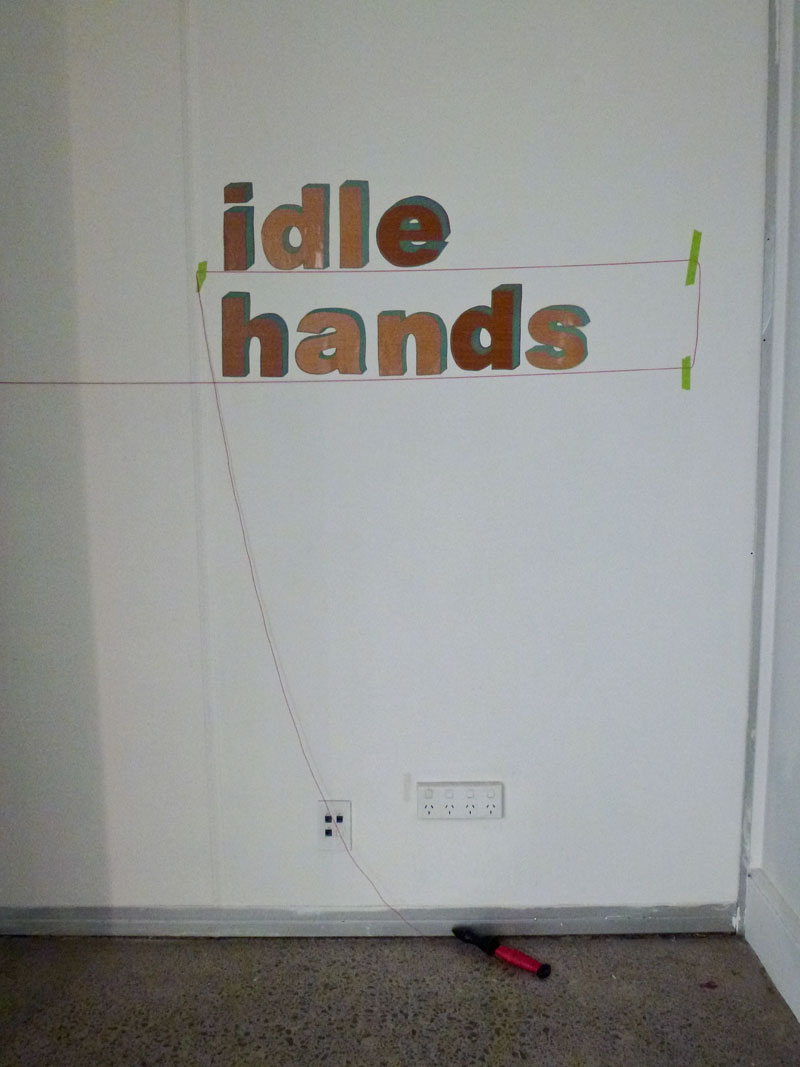
and the idea was to hand cut it out of wood grain wall vinyl – see An old, to mimic Gabrielles immaculate text drawing in a lazy manner. unfortunately, while it looked suitably lazy it was really quite time consuming and tedious. i decided to settle for just “An Old fashioned arrangement” utilising the trials I had already done, not minding that they were in different wood grains. but then I looked at the roll of vinyl and went nah, I am not cutting even one more letter. An old-fashioned did not seem much on its own, but the letters available could be reconfigured into “idle hands” which seemed apt for the situation.
not to be completely dissuaded from my original task I also made a plan B text work using the full quote:

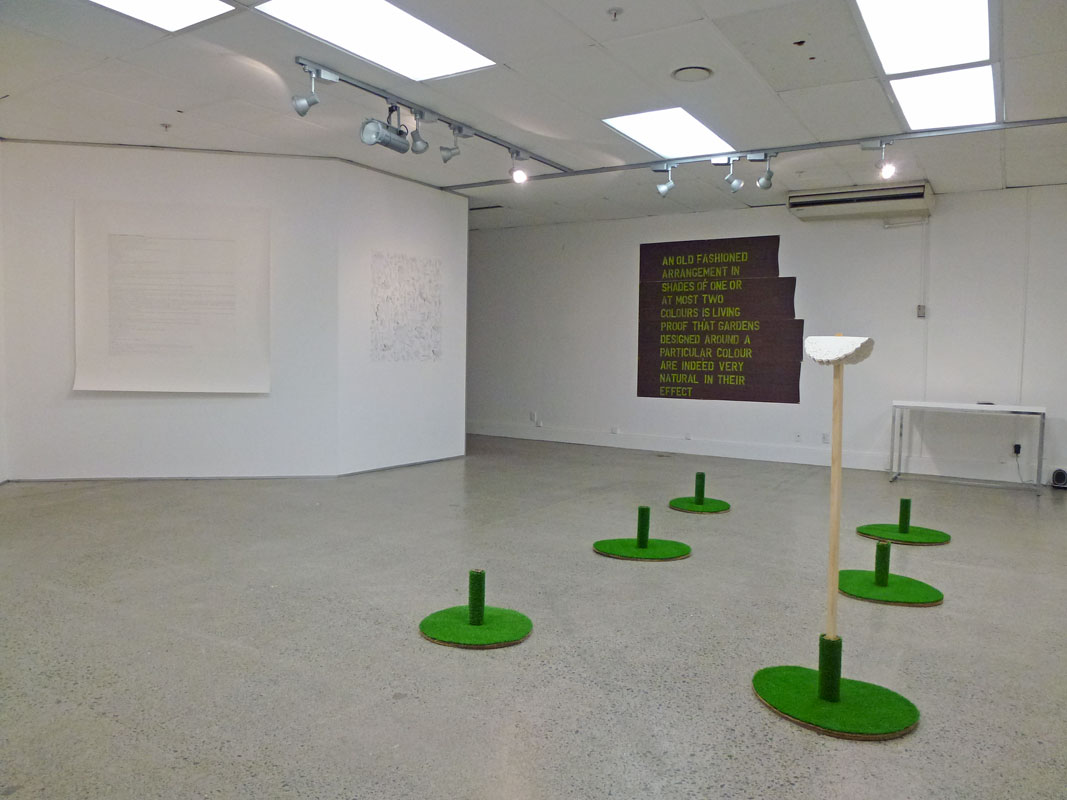
along the way I had found some super-cheap wood grain vinyl which prove so budget it would not even adhere to the wall, but it had a delightfully fake dark wood grain redolent of 70’s panelling. I made it into a wall panel with stencil, as you can see it is pinned and slumps slightly from the wall. It has no punctuation, as the stencil set provided none.

both text works fail gently, but in retrospect I think idle hands fails better through being more obscure, and by eventually falling off the wall itself.
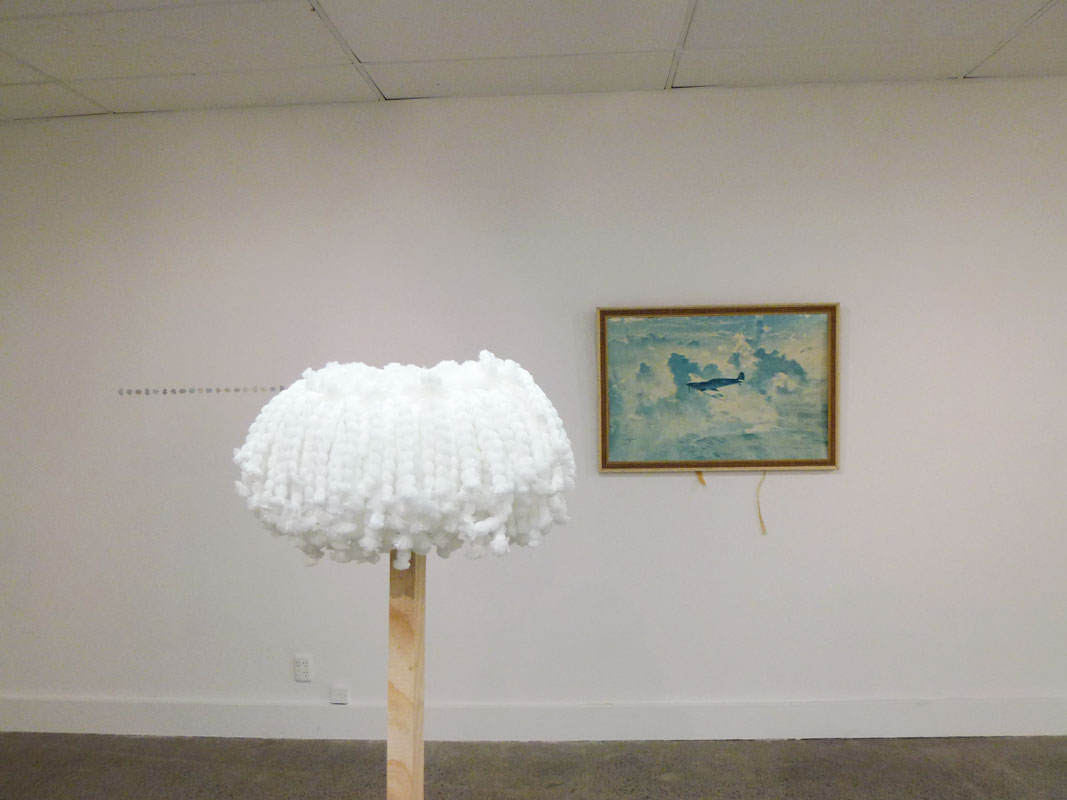
some installation shots from from Put Up Your Dukes Part Two at Pearce Gallery: 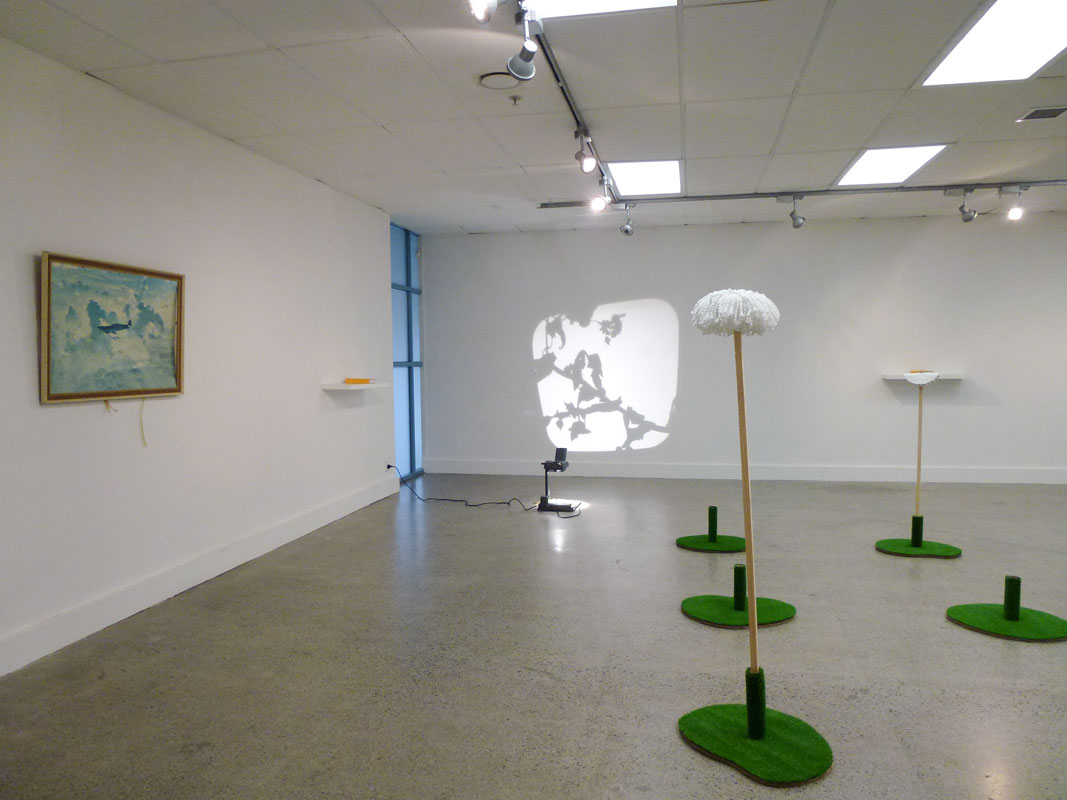
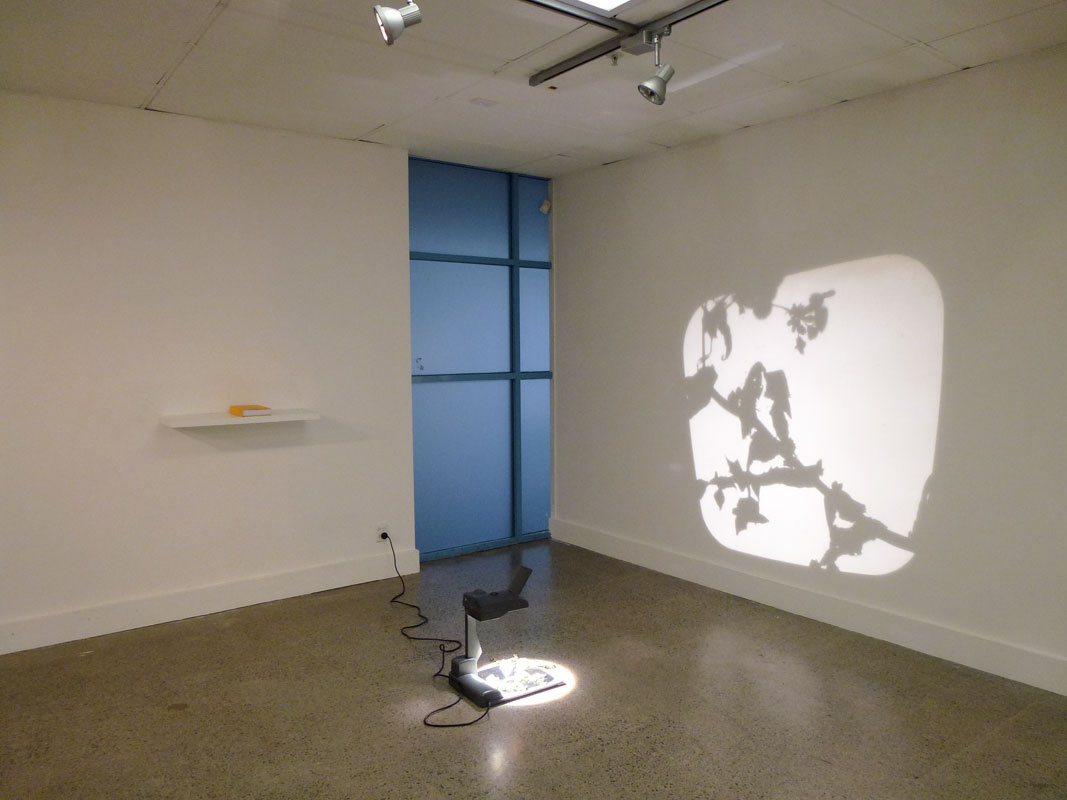
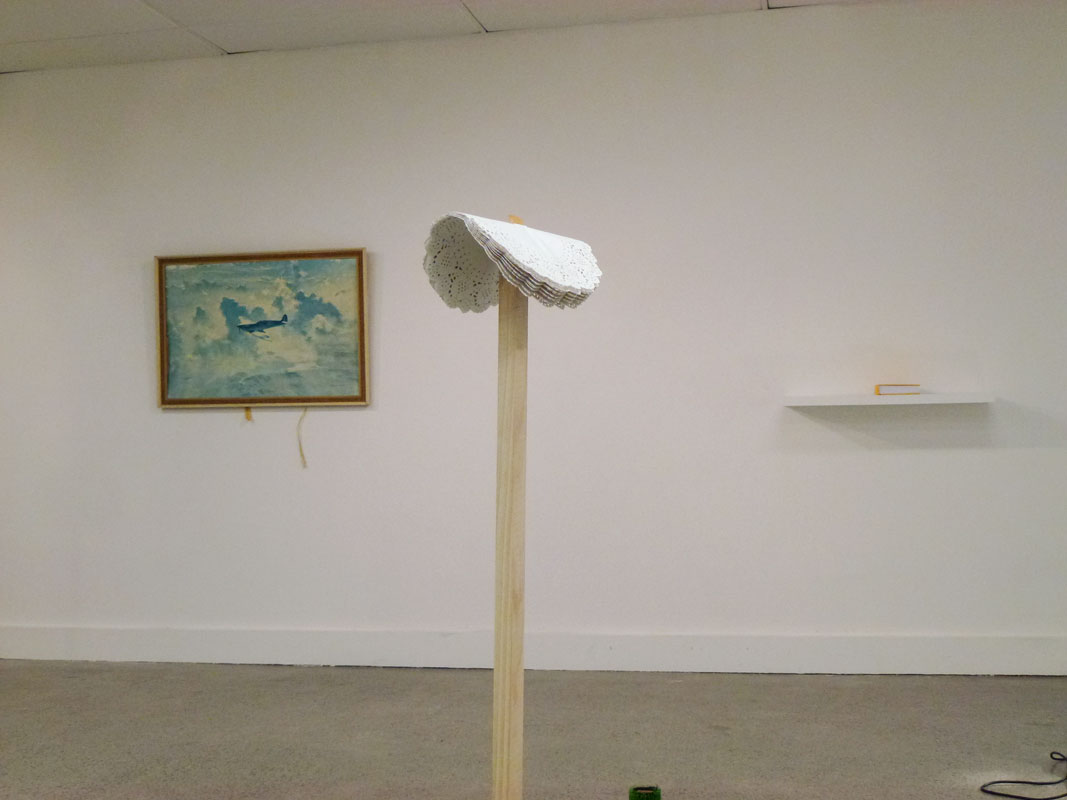
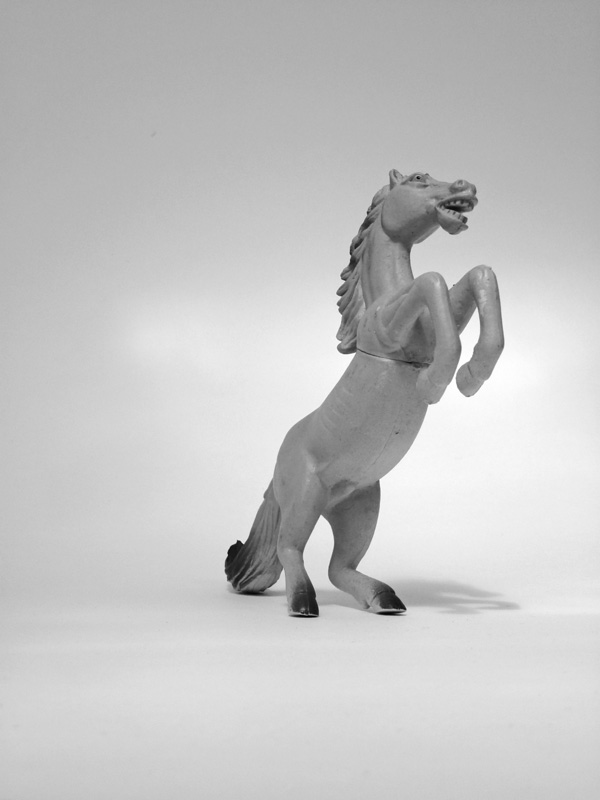
I have a show at Whitespace Contemporary Art early next year and have been mulling over what to call it. The show will involve some paintings, a few books of drawings and a number of yet to be finalised objects. There is always the straightforward option of Some New Paintings and Objects, and I also considered Horse, Pony, Donkey but I have decided on Avoiding Mastery. It has a decisive ring to it which clashes pleasingly with its directive to avoid getting too good at art making.
Ironically this interest in non-mastery has its genesis in my Master of Fine Arts study at the University of Auckland in the early 2000’s. At the time I couched it in terms of cheating and lying as strategies for art making, however now I am thinking more in terms of failure and resisting the status quo. Failure to do the right thing, failure to master the art of being normal (or more correctly normative), Failure to be polite and well behaved, failure of art to strive toward being more skilled and refined and conceptually erudite.
In general a failure to progress and a reluctance to endorse progression as (a) normal/natural and (b) desirable.
Time Based project #1
Hope Leaves The Body Slowly
At its inception hope fills the body in the way that air fills a balloon.
From this point hope leaves the body. Slowly, imperceptibly at first.
Hope leaves the body slowly.
Long after the mind has made the cognition of failure the body still holds hope. The body reminds the mind to hope, the mind informs the body of failure.
Long after the mind has acknowledged disappointment the body still contains hope.
Hope and disappointment form a contracting loop between mind and body. slowly the cognitive gap between hope and disappointment shrinks to nothing. At this point hope can be said to have left the body.
All that remains is disappointment
Disappointment is carried in the body like a scar, or perhaps more like a souvenir. The place where hope once lived.


TOMORROW is the opening of Put Up Your Dukes! Part Two at Pearce Gallery. In anticipation here is part two of book 1. If you are in Auckland come along to the opening/ book launch at 5 – 7.30pm, Pearce Gallery 130 St Georges Bay Road, Parnell.

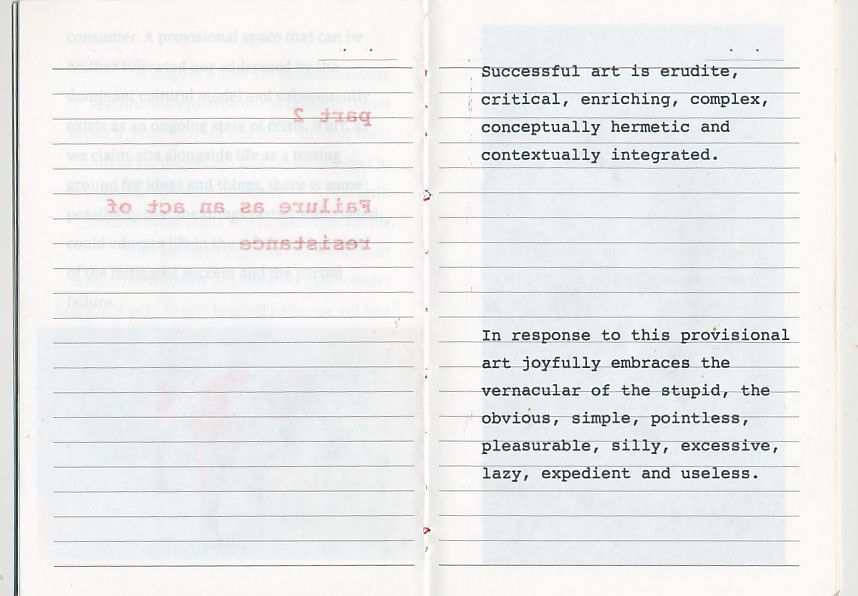


Book 1 continued:
page 12
In art, the problem of both success and failure rests on judgement. A judgement of either success or failure is by definition based on an expected outcome, either achieved or missed. In either case the assumption behind the judgment is not challenged. However, if judgement is postponed, the possibility of a third option arises, a position that that wavers between the two: the shaky territory of the provisional. The provisional allows for a mitigated success; something that holds together, just, but contains its own failure within it. It holds the door open to uncertainly, to multiple attempts, to self-doubt. It acknowledges the very human possibility that this is one of many tries at solving the problem on hand, and that this attempt is not necessarily the best but merely the most recent.
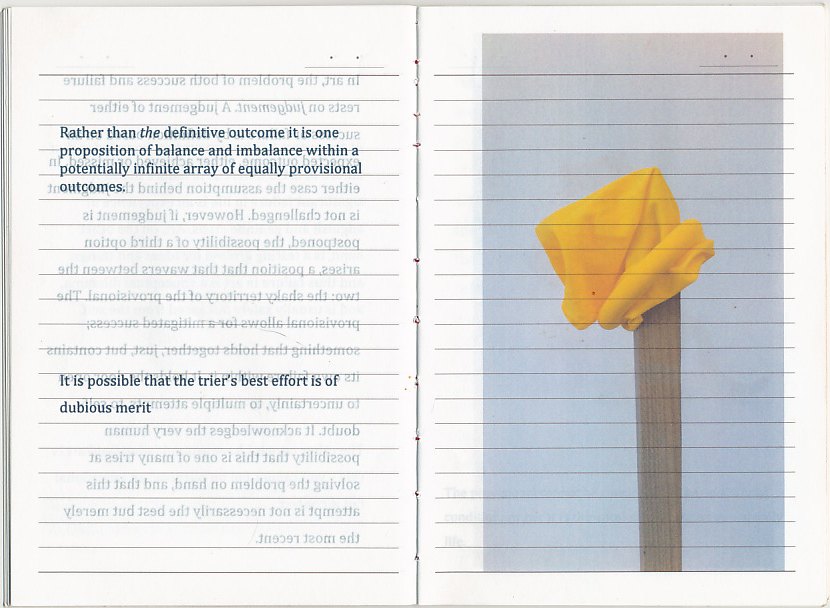
pages 12 & 13
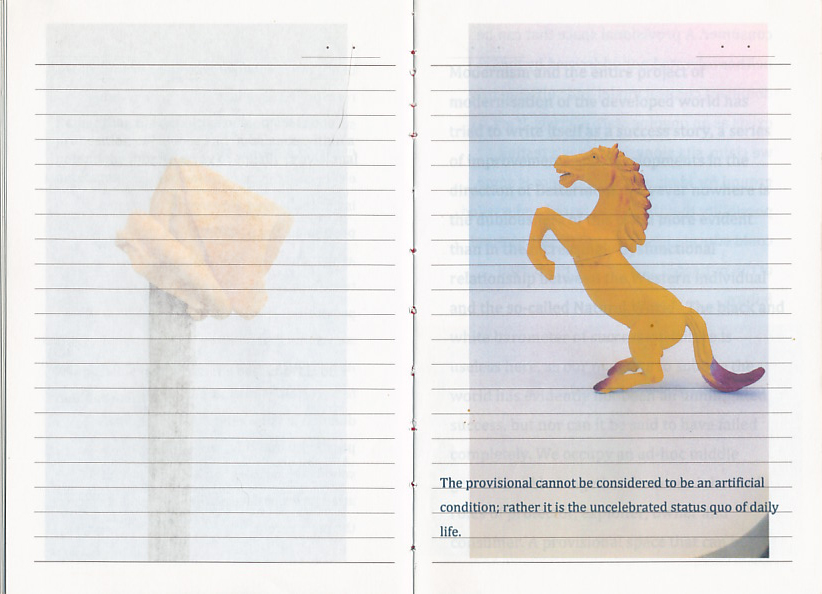
page 17 & 18
Modernism and the entire project of modernisation of the developed world has tried to write itself as a success story, a series of improvements and developments in the direction of Betterment. However nowhere is the dubiousness of this claim more evident than in the increasingly dysfunctional relationship between the Western individual and the so-called Natural World. The black and white barometer of success-or-failure is useless here, as our mandate to subdue the world has evidently not been an unmitigated success, but nor can it be said to have failed completely. We occupy an ad-hoc middle ground cobbled together from our inherited roles of protector, exploiter, owner and consumer. A provisional space that can be neither tolerated, nor addressed, by the dominant cultural model and subsequently exists as an ongoing state of crisis. If art, as we claim, sits alongside life as a testing ground for ideas and things, there is some possibility that the things tested and trialled could educate life in the subtle mid-ground of the mitigated success and the partial failure.
text wall work trial #5

Part 1
Resisting Failure is Futile
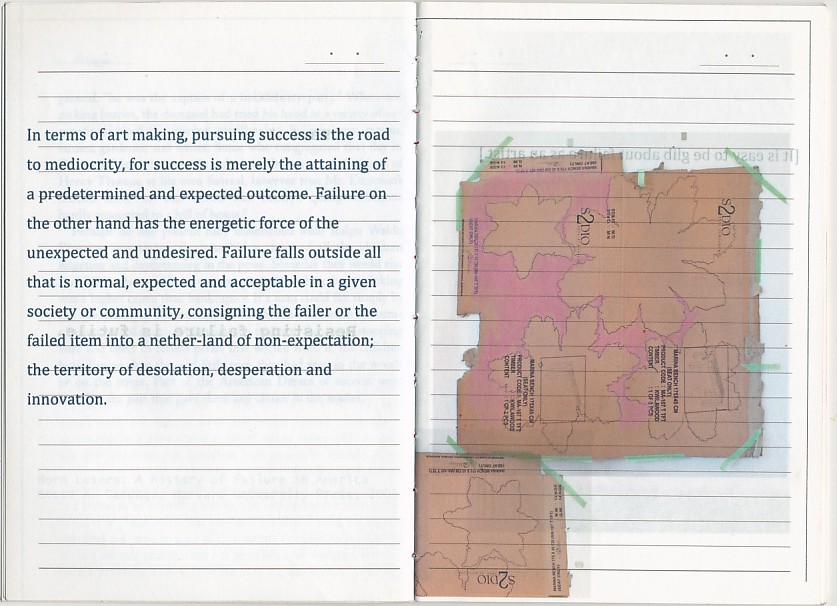


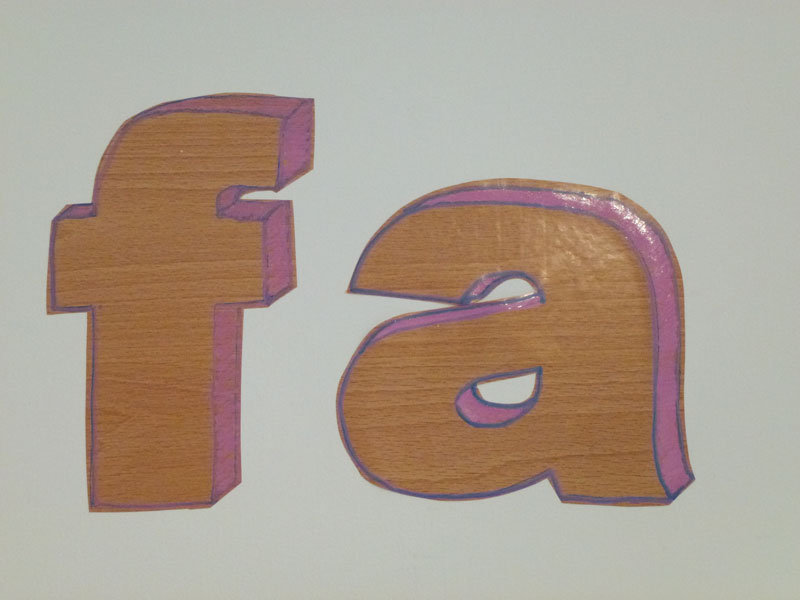
I am making a text wall work for Put Up Your Dukes! Part Two. It is a caption from The Modern Art of Flower Arranging by Elisabeth de Lestrieux, originally published 1982, (published in English 1986 Hamlyn). A rather fantastic book that I found at an op shop which has sat in my studio tempting me with its slightly faded photos and sincere enthusiasm, but has up til now evaded all attempts to be put to work as art. Maybe it is too good already. But still, I am going to try.
The two part Put Up Your Dukes! project uses the dubious construct of ‘nature’ as a foil for contesting our (Gabrielle Amodeo and my) inversely relational practices. I want this work to play to both the reconstruction of nature (wood vinyl and flower arranging) and to undermining the gravitas implicit in a large-scale text work. Gabrielle is making a immaculately drawn text work on paper, in addition to her immaculately made books from Part One of the project, so I want my text work to be large and somewhat crudely made. Which probably means that I have to hand cut it (as best I can, which is crudely). It would be much, much easier to get it vinyl cut, but I suspect that to really work it has to fall blindingly short of digital perfection.
The question is, do I go with the hand-drawn 3D shadow? Is the pink a step too far? Can I buy another pink pen once that one runs out? Is it too try-hard slacker? Or is it trying to be slacker cool but ending up embarrassingly contrived?
The quote has exactly 150 letters – that is a lot of pink-pen and blade knife.
 JILL SORENSEN