Travels with friends

I took TJ Demos on a bike ride with me; he talked, and I listened and pedalled. He spoke via the multi-layered avatar of a downloaded PDF, (the introduction to Decolonising Nature), read aloud via the Voice Aloud Reader app on my phone, delivered via Bluetooth to my in-helmet headphones. Demos talked about the way in which we apprehend nature impacting on how we assign responsibility for climate change, as we travelled over and alongside the motorway, passing manicured parks and rambuntious mixed-species urban thickets.

I breathed the rank air of the cars, and the soft air of trees with a momentary waft of roast potatoes as Demos promised catastrophic circumstances. I inhaled mudflat, and post-rain sewage as Demos evoked the plethora of voices speaking with him through the litany of thinkers and writers listed in numerical order in the notes accompanying each page, read out in full detail by my reader.

He spoke of the complicity of big industry as the cycleway crossed over a train yard and ended in an industrial park. We turned for home with the setting sun in our eyes and the possibility that we might, together, move beyond anthropocentrism.

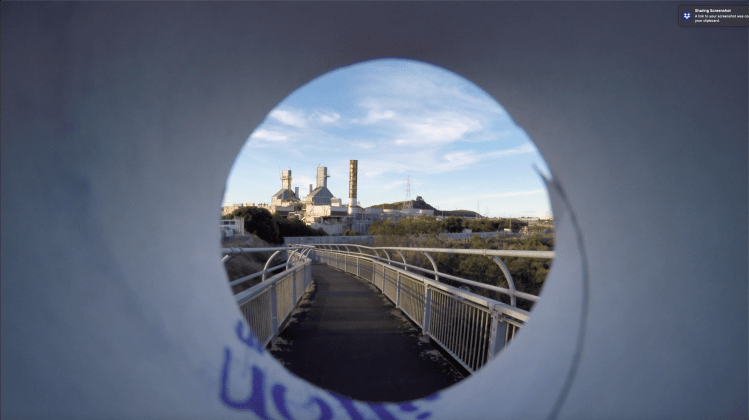
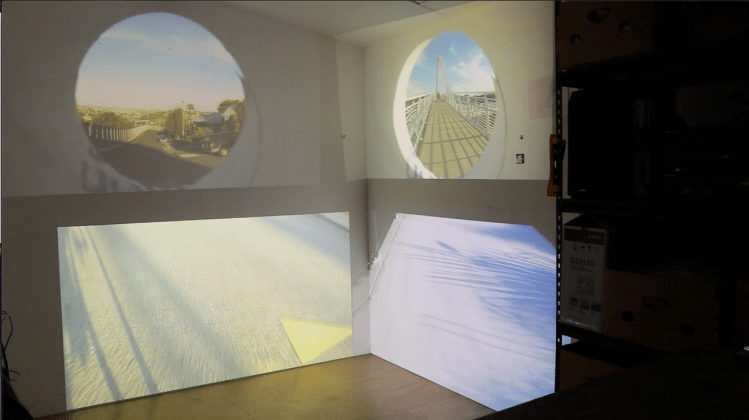
The next time I did this ride I took my recording devices with me and recorded what the bike saw, what I saw and what we heard.
This slideshow requires JavaScript.

Screenshot 2019-05-28 18.28.32
view here on Travels with Friends: TJ Demos, first minutes
Screenshot 2019-05-28 18.13.44
view here on Travels with Friends: TJ Demos, mid clip


Screenshot 2019-05-28 16.59.31

Screenshot 2019-05-28 17.04.26
what we saw


what he said:

“Political ecology necessitates engaging with these inequalities of our neocolonial present, just as centuries of colonialism initiated climate change.32 Accumulation by dispossession occurs when the fossil fuel economy in so-called developed nations creates the atmospheric pollution that, in causing global warming, now threatens the existence of small island nations, such as Kiribati and the Maldives, creates havoc in the Bangladesh’s delta, and melts perma- frost in Alaska. Or when agents of “green capitalism”—which grants post-1970s cor- porate practice a cosmetic environmental guise—buy tracts of rainforest in the Brazil- ian Amazon in order to plant eucalyptus monocultures (green deserts that contain no life) for biofuel that forces Indigenous and Quilombola (Afro-Brazilian former slave) communities from their once-biodiverse, natively managed land. What are these cases if not contemporary corporate colonialism?33 “

Notes:

32. In this regard, Eyal Weizman is right in arguing that climate change is the telos of colonial modernity. See Eyal Weizman and Fazal Sheikh, The Conflict Shoreline: Colonialism as Cli- mate Change in the Negev Desert (Göttingen: Steidl, 2015).

33. For more on this argument see Ashley Dawson, “Putting a Human Face on Climate Change,” in Climate Change and Museum Futures, ed. Fiona Cameron and Brett Neilson (Lon- don: Routledge, 2014), 207–18; and Santiago Navarro F. and Renata Bessi, “Green Neocolonialism, Afro-Brazilian Rebel- lion in Brazil,” trans. Miriam Taylor, Truthout, December 28, 2014, http://www.truth-out.org/news/item/28232-green- neocolonialism-afro-brazilian-rebellion-in-brazil.

Demos, T.J. Decolonizing Nature: Contemporary Art and the Politics of Ecology. Sternberg Press, 2016. p 17

FYI

This slideshow requires JavaScript.

Grounding Story

I was fortunate enough to be invited to present at the 7th The Association for the Study of Literature, Environment and Culture, Australia and New Zealand (ASLEC-ANZ) Biennial Conference: Grounding Story, Feb 13-15, 2019 at the University of New England, Armidale, Australia

This conference brought together writers, artists and activists involved in storying, or re-storying our shared experience of waking up to the Anthropocene,  the moment Donna Haraway* identifies as The Great Dithering,  a moment in which the impact of neo-liberal/capitalist care-less-ness can no longer be ignored, but Western culture in the thrall of this power, does not yet know what to do about it.

This conference shared the thinking and storying of people and organisations actively addressing this question of what to do about it. Importantly for me  was a shared focus on what we can do here and now, in our own lives, communities and practices. what was presented was an array of strategies for identifying and taking up agency within existent social structures rather than deferring all possibility of action to upward to a governmental power or a wider public who needs to care more, think more do more. The stories shared here are embedded in the understanding that change, political and cultural, can be driven or activated from within,  and seek to articulate new understandings and ways of thinking that can grow out from individuals and communities, building new cultural understandings from the bottom up. This is not to suggest that we abstain from direct political action, emphasising that the two are required in tandem to achieve the significant and sustained cultural shift our current predicament requires.


the conference was populated with facinating presentations, my only complaint was that, due to the concurrent schedule I was not able to attend everything that Ii absolutely wanted to see.

The following are a few of the individuals and groups that most strongly impacted on me.

Gabi Briggs (Aniwan)and Callum Clayton-Dixon (Aniwan) on the Anaiwan Language Revival project, and the associated visit to the Armidale Aboriginal Community Garden for the opening celebration of Gabi Briggs exhibition, “Surviving New England: Our Koori Matriarchs, Part One” and a shared meal with the community.


Dr Daniel Hikuroa (Ngāti Maniapoto), speaking on the Maoritanga of living in the embrace of Papa-tū-ā-nuku (the ancestor/god of the land) and Rangi-nui (the ancestor/god of the sky) and how this has directed his involvement inTe Awaroa – Voice of the River

the Australian collective The Kandos School of Cultural Adaptation introduced us to their latest project An Artist, Farmer, Scientist and a Planner Walk into A Bar…”  they also have a video for this ongoing project.

Sarah Edwards, Artist, presented her work The Growling Grass Frog and Its River Lethe: A sonic reflection on storytelling, memory and forgetting, based around an audio recording which is the sole remaining trace of the now extinct Australian Growling Grass Frog.

Elinor Scarth and Leoni Mhari (Edinburgh) performed their work We are sending a Scottish Landscape, an installation  of objects and moving image projections, unpacking each item from the travel-case as the narrated it story.

Michael Chew (Monash) presented  Images of hope, images of change: participatory approaches to north-south climate solidarity and shared his recent project Photo Voice in Bangladesh

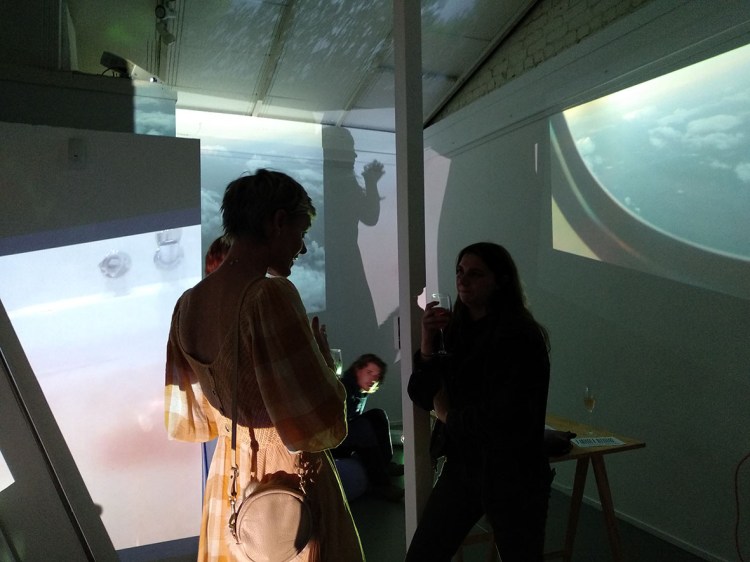
My contribution was I don’t know if the water knows how it will make its way to the sea; a dwelling space in a delightfuly vintage lecture hall as a quiet time-space for reflection throughout the conference, accompanied by a 20 minute  research presentation.

The Association for the Study of Literature, Environment and Culture, Australia and New Zealand provides a research network through to share information and ideas on the human relationship with non-human ecologies through literature, the arts and humanities in Australia and New Zealand.  ASLEC-ANZ


* Haraway, Donna Jeanne. Staying with the Trouble: Making Kin in the Chthulucene. Experimental Futures Technological Lives, Scientific Arts, Anthropological Voices. Durham London: Duke University Press, 2016.

how to water a tree

I broke my ankle in the holidays, this means that I cannot easily take a shower, I can, however, enjoy a long and relaxing bath with moon-boot propped on the edge of the tub.
The following is my process of getting this bathwater to the persimmon tree on the back lawn. Remember, I have a broken leg, I can’t carry a bucket of water.

This slideshow requires JavaScript.


Rm Conversation # 3: Between Elsewhere and Away

As a New Zealand European born in the sixties I have grown up in a society who belived itself to be cradled between infinate resourse and the no-place ‘away’. How do i now live, waking up to a biosphere in whom no material thing can be added or taken away, where everything that is something was something, and will continue to be some thing?


Inst wide view sml
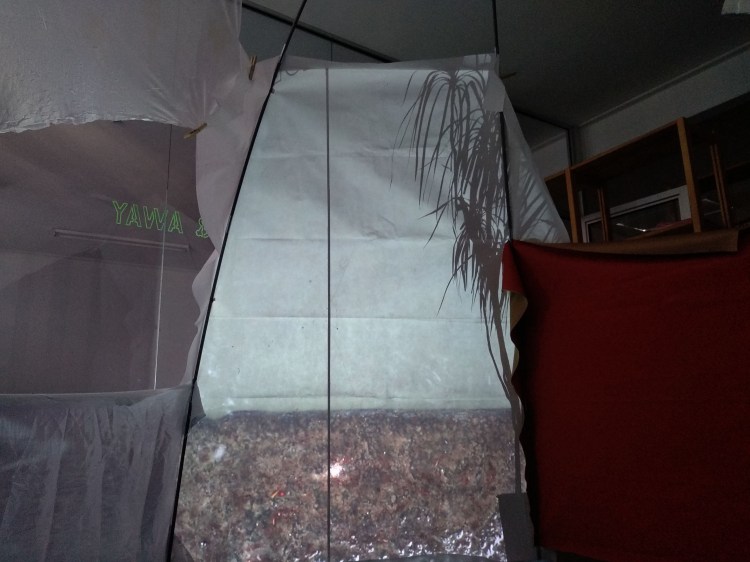
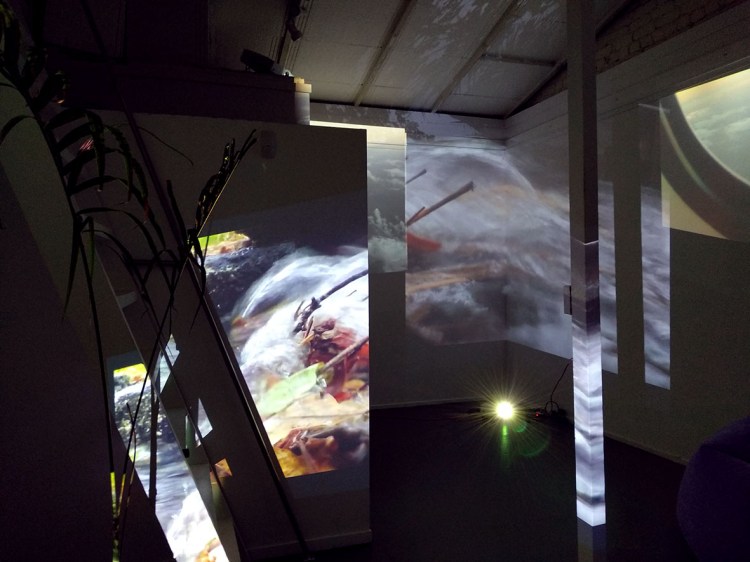
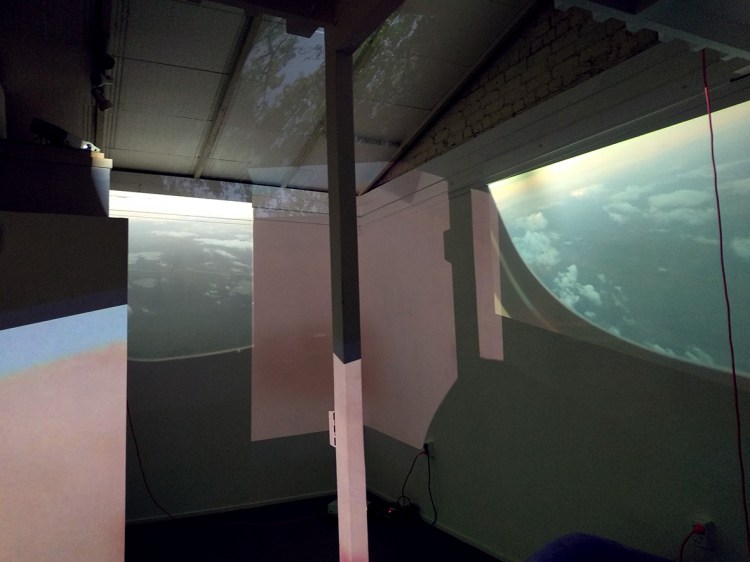
Rm Conversation Pit #3: installation including tent poles, fabric and video projection of waters pooling over a street curb as they make their way to the sea.


fabric detail sml


inst detail sml


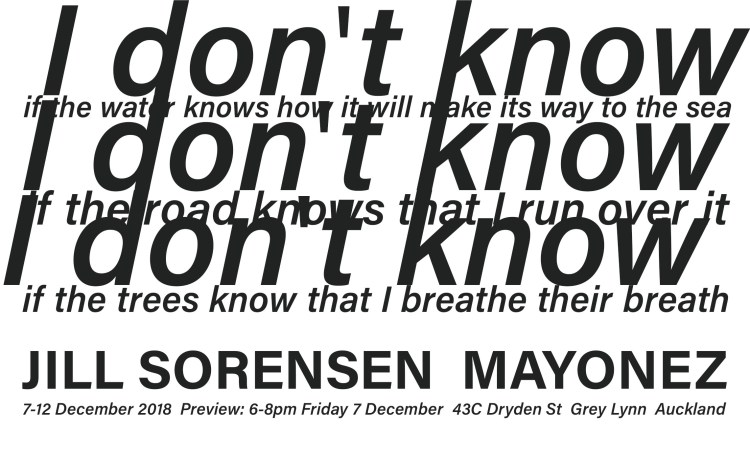
@ Mayonez on Friday


invite 1.jpg

I don’t know if the water knows how it will make its way to the sea.

I don’t know if the road knows that I run over it.

I don’t know if the trees know that I breathe their breath.


I invite you, for a moment, to imagine yourself positioned outside of anthropocentric humanism. Consider the possibility that thought, while currently the primary mode through which humans access our surroundings, is not innately the highest or most valid access mode in existence. We ourselves have many other access modes, such as imagining, dreaming, tasting, and feeling though we habitually consider these less valid. Similarly, nonhuman entities have access modes that may be inaccessible and foreign-seeming to us, and consequently we overlook them or deem them invalid.

The advent of the geological era of the Anthropocene, with its grudging acknowledgement that human activity has been the driver of this geological epoch change, leads humans into an imaginative crisis of world. It is the end of the Human World; the world effect within which we have been living for the past 10,000 years, in which humans are separate from, and autonomously act upon, the Natural world. The Anthropocene empties out this singular world affect. Now everyone has a world, water, running down the gutter or into my bath has a world. Rocks have a world, a world in which timescales are vastly larger than our own, so huge that we have perceived them as static. The Anthropocene makes us realise that when we look at a rock we are a human looking at rock; the shape of us in there in out looking.

Interestingly we are comfortable to scientifically imagine rocks as moving as liquid over a vast time scale, however we are less comfortable to philosophically imagine a rock as acting within its own world and world time. We accept scientifically that we are, or tellingly, our bodies are made up of an array of received and inherited DNA, that bacteria living in our gut are essential to our ongoing life, yet we feel uncomfortable to think ‘I am a heaving pile of entities cohabiting’. To acknowledge that not only do I have a micro biome, but that I am a biome.


immersive video installation that utilises the eye of the camera to capture moments of entities interacting with their world, flowing, fluttering, moving through or being moved over. It invites your human knowing, eye, mind and body, to reflect on other ways of being and knowing.

Rm Conversation Pit

THINKING SPACE

Over the next twelve weeks Rm Archive will host Rm Conversation Pit, a series of habitable installations and amicable talking events. To introduce the conversations: Installation #0.5 Thinking Space/ Mind Picnic. A thinking and reading space and the opportunity book in for a conversation.

2018-11-05 22.18.22
Rm Conversation Pit: installation #0.5. Thinking space/ mind picnic

Conversation #1  

19 – 27 November­­

Sharing in an intimate world: Rethinking human vs nature

sharing in an intimate world acknowledges the impossibility of maintaining an anthropocentric worldview[1] in an era of eco-crisis and invites us to tease out ways to orient ourselves within a biosphere in which we are continuous with the network of entities we previously called nature.


Conversation #2

29 – 12 December

The Agency of Things

Water, soil, rock, a tree, a chicken, a cat, some wheat, some excrement, a plastic bottle, a river. Our relationships with these things may be articulated as resources and waste that we need to manage but also as entities with whom our lives are intertwined. Both statements extort us to act responsibly toward these things, however the dynamic at stake in each is significantly different.


Conversation #3 

14 – 21 December

Between elsewhere and away: reimagining the suburban/urban home

Urban dwelling emerged from a culture in which we imagined our human selves as cradled between infinite earthly resource and a mythical ‘away’. Home became normalised as a house and garden, a two-part structure demarking an inside for human dwelling and an outside for all other entities.


What’s too read? more info on this page